

Journalism Isn’t Optional: Why Independent Media Is Essential in an Age of Nuclear Risk and Disinformation
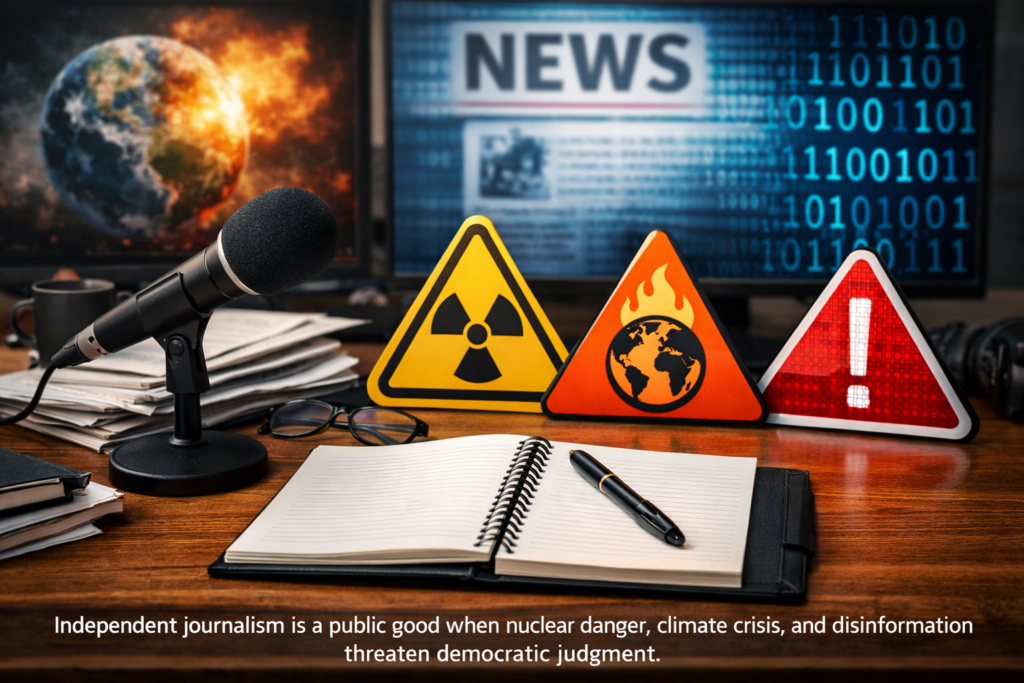
As nuclear danger rises, climate breakdown accelerates, and new technologies outpace public control, independent journalism becomes more than a profession. It becomes part of humanity’s survival infrastructure. The example of the Bulletin of the Atomic Scientists shows why fact-based, nonprofit media are indispensable when public debate is flooded with noise, pressure, and disinformation.
Journalism Isn’t Optional. It Is Essential
At a time when humanity faces converging dangers, one truth deserves to be stated plainly: journalism is not optional. It is essential.
Nuclear risk is rising again in a fractured geopolitical landscape. Climate change is moving faster than many governments are willing to act. Artificial intelligence, biotechnology, and other disruptive technologies are developing with enormous speed, while democratic oversight struggles to keep up. At the same time, disinformation spreads rapidly, public debate is distorted, and scientific facts are increasingly pushed aside by ideology, profit interests, and political convenience.
In such a moment, trusted journalism is not a luxury. It is a condition for democratic judgment.
Why this matters now
Modern societies are confronting threats that are complex, technical, and often easy to ignore until they become catastrophic. Radiation standards, arms control, ecological tipping points, digital manipulation, and biosecurity are not always topics that produce sensational headlines or quick commercial returns. But they shape the real conditions of life, security, and survival.
That is why journalism grounded in evidence matters so deeply. Not because it comforts people, but because it helps them see clearly.
The Bulletin of the Atomic Scientists has long worked in precisely this field. For decades, it has brought rigorous, science-based analysis into public debate on some of the gravest dangers facing humanity. Its mission is not only editorial. It is civic. It exists to make sure that the public and policymakers are not left navigating existential risks through propaganda, wishful thinking, or commercial media logic alone.
When media courage matters
A recent example illustrates the point well. Investigative journalists Lesley M. M. Blume and Chloe Shrager examined the implications of a United States executive order proposing reforms to the Nuclear Regulatory Commission that would weaken long-standing radiation exposure standards.
Their reporting highlighted a disturbing possibility: rolling back these protections could leave women and young girls disproportionately vulnerable to radiation harm, in some cases dramatically more so.
This was not a trivial regulatory story. It was a story about public health, scientific integrity, and unequal exposure to danger.
Yet major media outlets reportedly hesitated to publish the analysis. The subject was controversial. The political environment was tense. The commercial risks were obvious.
The Bulletin published it anyway.
That is what independent journalism looks like when it functions as it should. It does not ask first whether a story is convenient. It asks whether it is true, relevant, and in the public interest.
Why nonprofit journalism matters
Commercial media can do excellent work. Many journalists inside commercial newsrooms still produce brave and necessary reporting. But large media institutions operate under pressures that are not neutral: advertiser sensitivities, legal risk calculations, ownership interests, audience metrics, and political backlash.
These pressures do not always suppress truth directly. Sometimes they simply narrow the range of what is published, delayed, or framed as too risky.
Nonprofit journalism can create space where those pressures are weaker. At its best, it serves evidence and the public interest before shareholders, branding concerns, or short-term market calculations. That does not make nonprofit media automatically superior. But it does make certain kinds of journalism more possible: investigative work, expert reporting, long-range analysis, and difficult stories that powerful institutions would prefer to keep out of focus.
In an era shaped by nuclear danger, climate disruption, and technological acceleration, that difference becomes critically important.
Peace journalism needs facts, not fog
For peace-oriented media, this lesson is especially urgent. Peace journalism is sometimes mocked as soft, moralistic, or detached from hard realities. The opposite is true when it is done well.
Serious peace journalism is rigorous. It examines power, interests, escalation, propaganda, and preventable harm. It asks who benefits from militarisation, who pays the human price, which risks are being ignored, and what alternatives are systematically excluded from mainstream debate. It does not deny conflict. It tries to understand it more fully and more honestly.
That work depends on factual courage.
Without trusted journalism, public debate becomes vulnerable to theatrical politics, fear campaigns, and manipulated simplifications. Citizens are fed emotional reflexes instead of reality. Under those conditions, democratic societies become easier to steer toward confrontation, militarisation, and distraction from deeper risks.
Disinformation thrives where journalism weakens
Science is not undermined only by open censorship. It is also weakened through endless distraction, strategic confusion, and the flooding of public space with noise. In such an environment, lies do not need to fully defeat truth. They only need to exhaust it, delay it, or bury it under a thousand competing distortions.
This is one of the defining problems of our time.
The more dangerous and complex the world becomes, the more public communication rewards speed, outrage, and simplification. That is precisely why independent journalism matters more, not less. It slows the rush to manipulation. It tests claims. It checks evidence. It makes consequences visible. It helps societies distinguish between what is loudly asserted and what is actually true.
That function is not secondary to democracy. It is part of democracy’s nervous system.
A lesson for Friedensnews and beyond
For platforms committed to peace, disarmament, climate responsibility, and human security, the implications are clear. Journalism must remain at the centre. Not branding. Not tribal applause. Not mere opinion. Journalism.
That means verified facts, careful sourcing, understandable language, and the willingness to publish difficult truths even when they cut across dominant narratives. It also means supporting media structures that can survive without bending too easily to commercial or political pressure.
Independent journalism cannot by itself stop nuclear escalation, halt climate breakdown, or regulate dangerous technologies. But without it, societies become blinder, more manipulable, and less capable of timely action.
That is why journalism is not optional.
It is essential because reality is essential.
Conclusion
The public needs institutions that still take truth seriously when the stakes are high. It needs journalism that is not intimidated by controversy, not captured by market fear, and not seduced by propaganda. It needs media that remain loyal to evidence and the public interest when that loyalty becomes uncomfortable.
The example set by the Bulletin of the Atomic Scientists is therefore larger than one publication. It is a reminder of what journalism is for.
- Not decoration.
- Not content production.
- Not noise.
A democratic survival function.
What now?
If we want societies capable of responding intelligently to nuclear risk, climate disruption, and dangerous technological change, then independent journalism must be defended and funded as a public good. Readers, donors, civil society actors, and democratic institutions all have a role to play.
Because when truth is weakened, every other safeguard weakens with it.
Independent journalism that serves the public interest does not survive by magic. It survives because readers, supporters, and donors decide that fact-based reporting on nuclear danger, climate crisis, and technological risk is worth defending. Those who want to support the Bulletin of the Atomic Scientists can do so via its official donation page.
Posted in Abrüstung, Friedensbewegung, Friedensforschung, Friedensjournalismus, Gewaltprävention, Global, Menschenrecht




One Response to “Journalism Isn’t Optional: Why Independent Media Is Essential in an Age of Nuclear Risk and Disinformation”